

If you are researching tear trough fillers, you have probably seen the dramatic before-and-after photos and the under-eye prices that swing from a few hundred pounds to nearly a thousand. What is harder to find is a straight answer to the questions that actually matter: will this fix *your* dark circles, what can go wrong, and what does it really cost in the UK in 2026.
This guide is written from the buyer’s side. We are an independent skin-health reference, not a clinic, so we have no treatment to sell you. The honest summary up front: tear trough filler suits a fairly narrow group of people, the area carries real and occasionally serious risks, and for a lot of under-eye concerns it is the wrong answer entirely. Read the candidacy and risk sections before you book anything.
Table of Contents
- 1 What is tear trough filler, and who is it actually for?
- 2 What tear trough fillers treat (and what they don’t)
- 3 How the procedure works
- 4 Who tear trough fillers suit
- 5 Are tear trough fillers safe? The risks explained
- 6 How long do tear trough fillers last?
- 7 Tear trough filler cost in the UK (2026)
- 8 A note on “before and after” photos
- 9 Tear trough filler vs the alternatives
- 10 How to choose a safe practitioner
- 11 When to see a GP or dermatologist
- 12 Frequently asked questions
- 13 The bottom line
- 14 Sources
What is tear trough filler, and who is it actually for?
The short answer
Tear trough filler is a hyaluronic acid gel injected into the hollow between the lower eyelid and the cheek to soften under-eye shadows caused by lost volume. It works well only on the right candidate: someone with a *true hollow* (a shadow cast by a groove), good lower-lid skin and no significant eye bags. It does not lighten genuine dark pigment, fill nothing, smooth crepey fine lines, or fix puffy “eye bags” from herniated fat, and in the wrong case it can make the under-eye look worse. The tear trough sits next to thin skin and major blood vessels, so complications here can be more serious than filler elsewhere on the face. In the UK it is a private cosmetic treatment costing roughly £350 to £850+ per syringe, lasting about 9 to 18 months.
- Treats under-eye hollows and shadows, not fine lines or pigment
- Hyaluronic acid filler placed by a trained medical injector
- Real risks: Tyndall blue tint, swelling, rare vascular/vision issues
- UK cost roughly £350-£850; results last about 9-18 months
If you take one thing from this page: match the treatment to the actual *cause* of your under-eye concern before you spend a penny. Filler fixes hollows. It does little or nothing for pigment, eye bags or fine lines. Getting that wrong is the most expensive mistake people make here.
What tear trough fillers treat (and what they don’t)
The “tear trough” is the groove that runs from the inner corner of the eye down towards the cheek. As we age, the cheek fat pad descends and the bone and soft tissue around the eye socket lose volume, deepening that groove. The result is a shadow that reads as tiredness, even after a full night’s sleep.
Tear trough filler treats this by injecting a gel, almost always a hyaluronic acid (HA) filler, into or just above the hollow to smooth the step between eyelid and cheek. Hyaluronic acid is a sugar that occurs naturally in skin and binds water, which is why HA fillers are the standard choice here: they add gentle volume and, crucially, they can be dissolved if something goes wrong.
A few things this treatment is not:
- It is not a treatment for true skin pigmentation under the eye. If the skin itself is darker (often hereditary, and more common in some skin tones), filler will not lighten it.
- It is not a fix for loose, crepey lower-lid skin on its own.
- It is not a treatment for puffy “eye bags” caused by herniated fat. In some cases filler makes those look heavier.
How the procedure works
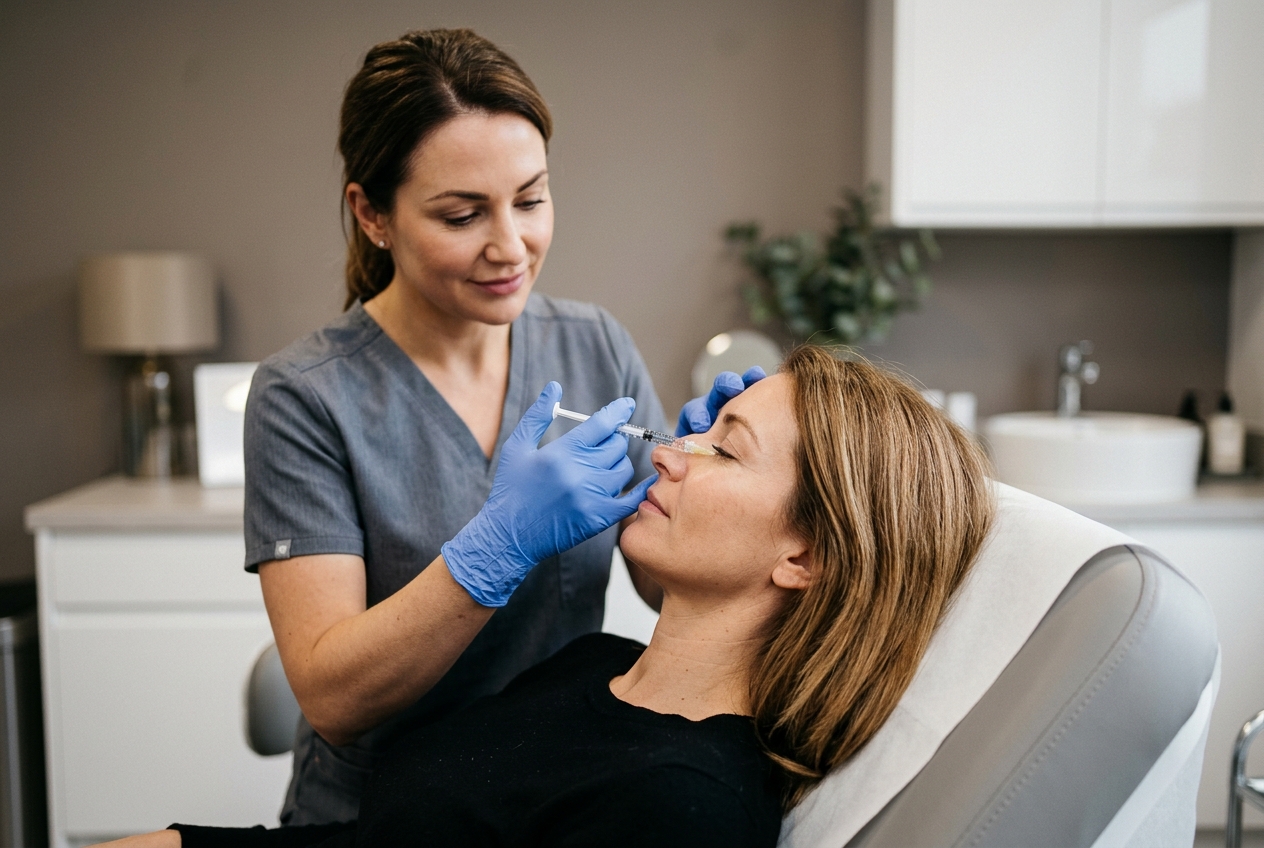
A typical process at a reputable UK clinic looks like this:
1. Consultation and assessment. A trained practitioner examines the under-eye area, works out what is actually causing your concern, and decides whether you are suitable. This step should rule people out, not just book them in. 2. The injections. Small amounts of HA filler are placed deep, usually down against the bone, using either a needle or a blunt-tipped cannula. A cannula is often preferred in the tear trough because it can reduce the chance of piercing a blood vessel. 3. Moulding and review. The practitioner smooths the filler and checks symmetry. Often less is used than you would expect: over-filling the tear trough is a common cause of a puffy, “did something” look. For a true tear trough, around 1ml (one syringe) is frequently enough for both eyes. 4. Aftercare. Some swelling and bruising in the first days is normal. A review a couple of weeks later checks the settled result, because the area holds water and can look fuller at first.
According to the NHS and the British Association of Dermatologists, HA fillers are temporary. The gel is gradually broken down by the body, so results fade and top-ups are needed to maintain them.
Who tear trough fillers suit
The best candidates tend to share these features:
- A true hollow under the eye, where the shadow comes from lost volume rather than pigment. A rough home check: gently lift the cheek skin upward, or shine a light from below. If the dark area is a shadow that lightens when the hollow is filled with light, volume loss is the likely cause.
- Good skin quality in the lower lid, without heavy crepey wrinkling.
- No significant eye bags from protruding fat.
- Realistic expectations and an understanding that this is a maintenance treatment, not a one-off cure.
You are likely not a good candidate if:
- Your dark circles are mainly pigment (the skin itself is darker). Filler does not lighten pigment.
- You have prominent eye bags or a lot of fluid retention and puffiness.
- You have very thin or lax lower-lid skin, where filler can show through as a bluish lump (the Tyndall effect) or settle unevenly.
- You are pregnant or breastfeeding, have an active skin infection in the area, or have certain medical conditions. A good clinic screens for these.
Honest framing: a meaningful share of people who ask for tear trough filler are better served by a different treatment, or by nothing at all. A practitioner willing to turn you away is a good sign, not a bad one. This is exactly why so many results that go viral as “tear trough filler gone wrong” trace back to treating the wrong candidate in the first place.
Are tear trough fillers safe? The risks explained
Every injectable carries risk, but the tear trough deserves extra caution because of where it sits. The NHS, the British Association of Dermatologists and DermNet all flag that filler complications, while uncommon, can be serious. So: tear trough fillers are reasonably safe in experienced, qualified hands and far riskier in inexperienced ones. Operator skill matters more here than almost anywhere else on the face.
Common, usually short-lived side effects:
- Swelling and bruising (the under-eye bruises readily).
- Tenderness, redness or lumpiness at the injection points.
- Temporary asymmetry while the filler settles.
Issues that are more common specifically in the tear trough:
- Puffiness and fluid retention. HA draws water, and the under-eye area is prone to holding it. This can leave a persistent puffy or “boggy” look that may need the filler dissolved.
- Tyndall effect. Filler placed too superficially under thin skin scatters light and looks bluish-grey.
- Lumps and migration. Product can move or clump, sometimes months later, and may need correcting.
Rare but serious risks (seek urgent help):
- Vascular occlusion. If filler is injected into or compresses a blood vessel, it can block blood supply to the skin. Near the eye this is the most feared complication because, in very rare cases, it has been associated with vision loss. Warning signs include sudden severe pain, skin that turns pale or blotchy, or any change in vision. This is a medical emergency.
- Infection or, very rarely, delayed inflammatory nodules.
Most serious complications are linked to inexperienced injectors and poor technique. One genuine reassurance with HA fillers: they can be dissolved with an enzyme (hyaluronidase), so a properly trained injector has a way to reverse problems. Permanent or non-HA fillers offer no such safety net and are not recommended for the tear trough.
A note on UK regulation
In the UK, dermal fillers are not currently regulated as tightly as you might assume, and the law around who can inject and where is changing. In many settings, anyone can legally set up to inject filler, which is exactly why vetting a properly trained, insured practitioner falls on you as the buyer. The Joint Council for Cosmetic Practitioners (JCCP) maintains a public register of practitioners meeting a recognised standard, and is a sensible starting point when checking credentials. In England, clinics carrying out certain procedures should also be considering Care Quality Commission (CQC) registration, and medical injectors should hold current GMC, GDC or NMC registration.
How long do tear trough fillers last?
HA tear trough filler is temporary. UK clinics commonly quote longevity in the region of 9 to 18 months, though some quote from as little as 6 months. The figure varies a lot between individuals depending on metabolism, the product used, how much was placed and your own physiology. Many people find filler in the tear trough lasts towards the longer end of that range, because there is little muscle movement in the area to break it down.
For context, named UK clinics quote: sk:n Clinics around 12 months, Dr David Jack around 12 months, Harley Street MD around 6 months, and the Harley Street Skin Clinic 2026 cost guide up to 18 months. To maintain the look, expect a top-up roughly every 9 to 18 months once results fade, rather than on a fixed schedule.
Tear trough filler cost in the UK (2026)
Pricing depends on the clinic, the practitioner’s seniority, your location and how much product you need. As a buyer, note that the under-eye area is almost always priced per syringe (per ml), not per “treatment”, and a true tear trough often needs only one syringe for both eyes.
Tear trough filler costs roughly £350 to £850+ per syringe in the UK in 2026, with national chains at the lower end and senior London medical injectors at the top. Here are real published 2026 prices from named UK clinics so you can see the spread. Confirm directly before booking, as prices change.
| Clinic | Location | Price (per syringe / session) | Notes |
|---|---|---|---|
| sk:n Clinics | National | From £375 | 0% finance options advertised; free consultation |
| Harley Street MD | London | £450 per syringe | £150 deposit to book |
| Dr David Jack | London (Harley Street / Belgravia) | £750 (some practitioners £850) | Price varies by practitioner |
| Harley Street Skin Clinic (2026 cost guide) | UK average | £350 to £800 | Their own market estimate, usually one syringe |
What pushes the price up or down:
- Practitioner credentials. A doctor, dentist or nurse prescriber with strong aesthetic experience usually costs more than a non-medical injector, and in this delicate area that premium is often worth paying.
- Location. London and major cities are dearer.
- Product and volume. Premium HA brands and larger volumes cost more, though more is rarely better here.
- Reviews and dissolving. Check whether follow-up reviews are included, and whether the clinic can (and will) dissolve filler if needed.
Tear trough filler is a cosmetic treatment, so it is not available on the NHS. The NHS only treats eye-area concerns when there is a genuine medical need (for example certain lid conditions), never for appearance.
Be wary of unusually cheap deals and “filler parties”. The saving is not worth it in an area where a poor outcome can affect your vision, and where correcting a bad result (dissolving and re-treating) often costs more than doing it properly once.
A note on “before and after” photos
Tear trough filler before-and-after photos are the main reason people book, and the main way they get misled. A few buyer-side rules:
- Ask to see the clinic’s own patients, not stock images or manufacturer marketing. A skilled injector will have plenty of their own tear trough cases.
- Look for photos taken at the same angle and lighting. Shadows under the eye change dramatically with lighting, which can fake a result that filler did not actually create.
- Ask to see results at two-plus weeks, once swelling has settled, not same-day photos that flatter the outcome before the area has calmed down.
- Be sceptical of dramatic transformations on someone who clearly had eye bags or pigment, not a hollow. That before-and-after is selling you an outcome you may not get.
Tear trough filler vs the alternatives
Filler is one option among several, and the right choice depends entirely on what is causing your under-eye concern. Here is an honest comparison.
| Option | Best for | Downsides | NHS available? |
|---|---|---|---|
| Tear trough HA filler | True hollowing from volume loss | Risk in a delicate area, puffiness, needs top-ups, operator-dependent | No (cosmetic) |
| Topical care (retinoids, vitamin C, eye creams, SPF) | Mild crepiness, prevention, pigment support | Slow, modest results, will not fill a real hollow | No |
| Pigment-targeting routes (treating true dark pigment) | Genuinely pigmented dark circles | Pigment is stubborn; manage expectations; see a professional | No |
| Lifestyle factors (sleep, hydration, allergy control, stopping smoking) | Puffiness and shadowing made worse by lifestyle | Helps at the margins, not a structural fix | Free |
| Lower-lid surgery (blepharoplasty) | Prominent fat-pad eye bags and lax skin | Surgical risk, recovery, cost | Only if medically indicated |
| Polynucleotides / skin-quality injectables | Improving thin, crepey under-eye skin texture | Newer, evidence still developing, costs add up | No |
A few takeaways from that table:
- If your concern is shadow from a hollow, filler is genuinely a reasonable option.
- If your concern is bulging eye bags, no filler fixes that. Surgery is the route, and you should see an appropriate specialist. Sagging in the wider mid-face and jaw is a different problem again, which we cover in our guide to jowls.
- If your concern is true pigment, manage expectations: this is the hardest under-eye problem to shift, and filler will not touch it.
- If your concern is fine lines and texture, start with good skincare and sun protection. We cover this in more depth in our guide to under-eye wrinkles.
How to choose a safe practitioner
If you decide to go ahead, this checklist matters more in the tear trough than almost anywhere:
- Choose a medically qualified injector (doctor, dentist or nurse prescriber) with specific tear trough experience, or at minimum a practitioner on the JCCP register.
- Confirm they hold current professional registration (GMC, GDC or NMC) and that the clinic is appropriately regulated for your nation of the UK (CQC in England, HIW in Wales, HIS in Scotland).
- Ask which product they use and confirm it is a hyaluronic acid filler that can be dissolved.
- Ask whether they keep hyaluronidase on site to reverse problems, and whether they are trained to manage a vascular occlusion.
- Ask to see before-and-after photos of their own tear trough work, not stock images.
- Confirm a proper consultation and review are included, and that you are not pressured into a same-day decision.
- Confirm they are insured and that the premises are clean and clinical.
If anyone offers permanent filler for your tear troughs, declines to discuss complications, or rushes you, walk away.
When to see a GP or dermatologist
See a GP or an appropriate clinician if:
- You have under-eye changes that are new, one-sided or rapidly changing, which should be checked rather than treated cosmetically.
- You think your dark circles might be linked to a medical cause (such as anaemia, allergies, thyroid problems or eczema around the eyes).
- You have had filler and develop sudden severe pain, skin colour changes, or any change in vision. Treat this as an emergency and seek urgent medical help straight away.
- You are unsure whether your concern is hollowing, pigment or eye bags, and you want an unbiased opinion before paying a clinic that sells the treatment.
For how to access dermatology care in the UK, including NHS referral routes and going private, see how to see a dermatologist in the UK.
Frequently asked questions
How much do tear trough fillers cost in the UK?
Are tear trough fillers safe?
How long do tear trough fillers last?
Do tear trough fillers get rid of dark circles?
Can tear trough filler be dissolved?
Does tear trough filler hurt?
Why is under eye filler sometimes not recommended?
The bottom line
Tear trough filler is a legitimate, useful treatment for the right person: someone with a true under-eye hollow, good skin quality and realistic expectations, treated by a skilled medical injector using a reversible HA filler, for roughly £350 to £850+ per syringe. For pigment, eye bags or fine lines, it is often the wrong tool, and choosing the cheapest option in such a delicate area is a false economy. Diagnose the cause first, then decide.
This is general information, not medical advice. Costs, suitability and results vary from person to person. See a GP or dermatologist about your own skin, and get a written quote and a proper consultation from any clinic before you commit.
Sources
- NHS: Dermal fillers (safety, what to consider, regulation)
- British Association of Dermatologists (BAD): patient information on fillers and skin ageing
- DermNet: dermal fillers and complications
- NICE: guidance on cosmetic procedures and patient safety
- Joint Council for Cosmetic Practitioners (JCCP): practitioner register and standards
- Medicines and Healthcare products Regulatory Agency (MHRA): regulation of dermal fillers in the UK
- UK clinic pricing pages, accessed June 2026: sk:n Clinics, Harley Street MD, Dr David Jack, Harley Street Skin Clinic 2026 cost guide (cited as provider examples, not endorsements)