
The Dermatology Life Quality Index (DLQI) was written by Professor A Y Finlay and Dr G K Khan and first published in 1994. This guide explains who it is for, how it is scored, what the scores mean, the research behind it, and how to get it and license it.
The short answer
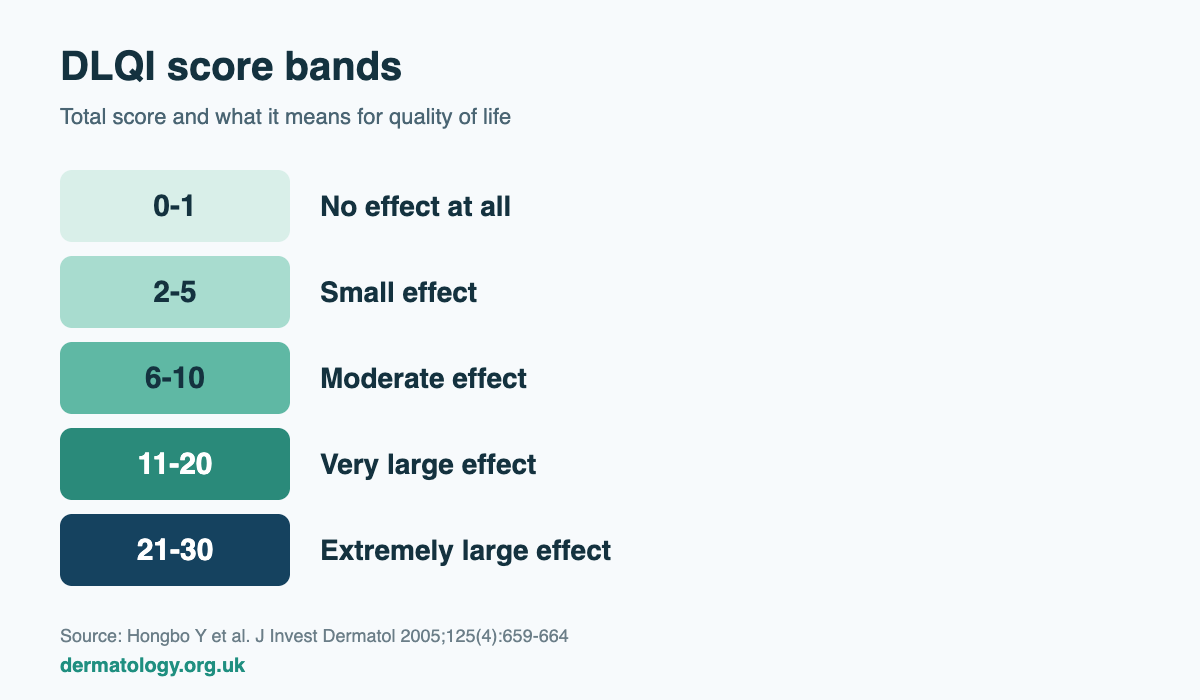
The Dermatology Life Quality Index (DLQI) measures health-related quality of life of adult patients with a skin disease. It is for adults aged 16 and over, has 10 questions, asks about the last 7 days, and gives a total score from 0 to 30. Scores are grouped into bands: 0-1 no effect at all on patient's life; 2-5 small effect; 6-10 moderate effect; 11-20 very large effect; 21-30 extremely large effect.
Table of Contents
How the DLQI is scored
Each answer is scored as follows: Very much 3, A lot 2, A little 1, Not at all 0, Not relevant 0, unanswered 0. The answers are added together to give a total from 0 to 30. Higher scores mean a bigger impact on quality of life.
Respondents should complete it on their own, without being guided towards any answer, and the score numbers must not be printed next to the answer options. Under Cardiff’s general guidance, a questionnaire with one unanswered question can still be scored, but two or more unanswered questions make it invalid.
What DLQI scores mean
| DLQI score | Effect on quality of life |
|---|---|
| 0-1 | No effect at all on patient's life |
| 2-5 | Small effect |
| 6-10 | Moderate effect |
| 11-20 | Very large effect |
| 21-30 | Extremely large effect |
Source: Hongbo Y et al. J Invest Dermatol 2005;125(4):659-664. doi:10.1111/j.0022-202X.2005.23621.x.
What counts as a meaningful change? A change of at least 4 points is considered clinically important for general inflammatory skin conditions (Basra et al. Dermatology 2015;230(1):27-33. doi:10.1159/000365390).
Who the DLQI is for
Adults aged 16 and over.
Authors: Professor A Y Finlay and Dr G K Khan. First published: 1994. Original paper: Finlay AY, Khan GK. Clin Exp Dermatol 1994;19(3):210-216. doi:10.1111/j.1365-2230.1994.tb01167.x.
Copyright statement: © Dermatology Life Quality Index. A Y Finlay, G K Khan, April 1992. By agreement, Cardiff University now owns and administers the copyright.
It is available in more than 140 languages. Every translation goes through full linguistic validation, with two independent forward translations, two independent back translations and further rounds until the translation is accurate. Cardiff also publishes an official free app, 'DLQI: The Official App', for Android and iOS.
Research and validation
- Used in 454 randomised controlled trials across 69 diseases and 43 countries (Vyas J et al. Br J Dermatol 2024;190:315-339)
- 207 studies describe validation aspects (Vyas J et al. Acta Derm Venereol 2024;104:adv41120)
- Used as the benchmark in validating 101 other quality-of-life instruments (Johns JR et al. J Eur Acad Dermatol Venereol 2025;39:631-679)
- Routine clinical practice: 287 articles across 56 countries (Vyas J et al. Clin Exp Dermatol, llaf343, doi:10.1093/ced/llaf343)
- Comprehensive review 1994-2007 (Basra MKA et al. Br J Dermatol 2008;159(5):997-1035)
- Mapping DLQI to EQ-5D utility values (Ali FM et al. Qual Life Res 2017;26:3025-3034)
- Rule of Tens in severe psoriasis (Finlay AY. Br J Dermatol 2005;152(5):861-867)
- DLQI as a psoriasis referral triage tool (Atwan A et al. Br J Dermatol 2017;177(4):e136-e137)
- HOME VII consensus recommendations for atopic eczema trials (Thomas KS et al. Br J Dermatol 2021)
How to get the DLQI and when you need a licence
Patients and clinicians can use the DLQI, in any available language, for routine clinical care without a licence and at no charge. It can be downloaded from Cardiff University’s DLQI page. Data collected as part of routine care can also be analysed and published without a licence.
Students need a free licence, which must be requested by a member of staff at their institution, usually the research or medical supervisor, through Cardiff’s online form. A separate licence is needed for each questionnaire.
Any other use, such as a research study, needs a licence first. Cardiff charges per patient: £18 in the UK and $26 (USD) in the rest of the world, with VAT possibly payable in the UK and EU. The charge is based on the number of patients the questionnaire is given to, including everyone screened.
The wording, format and question order cannot be changed. Electronic versions need Cardiff’s formal permission, and the copyright statement must stay visible.
Related questionnaires
The DLQI is one of a family of quality-of-life measures developed at Cardiff University. See the full guide to dermatology quality of life questionnaires, or the individual guides: CDLQI · FDLQI · IDQOL · CADI · DFI · PDI.
To score how much psoriasis is on the skin, rather than its effect on daily life, use our PASI score calculator.
To score the visible signs of eczema, such as redness, thickness and scratching, use our EASI score calculator.
Frequently asked questions
What does the DLQI measure?
Who is the DLQI for?
How is the DLQI scored?
What is a high DLQI score?
What change in DLQI score is clinically important?
Is the DLQI free to use?