
The Children's Dermatology Life Quality Index (CDLQI) was written by Dr M S Lewis-Jones and Professor A Y Finlay and first published in 1995. This guide explains who it is for, how it is scored, what the scores mean, the research behind it, and how to get it and license it.
The short answer
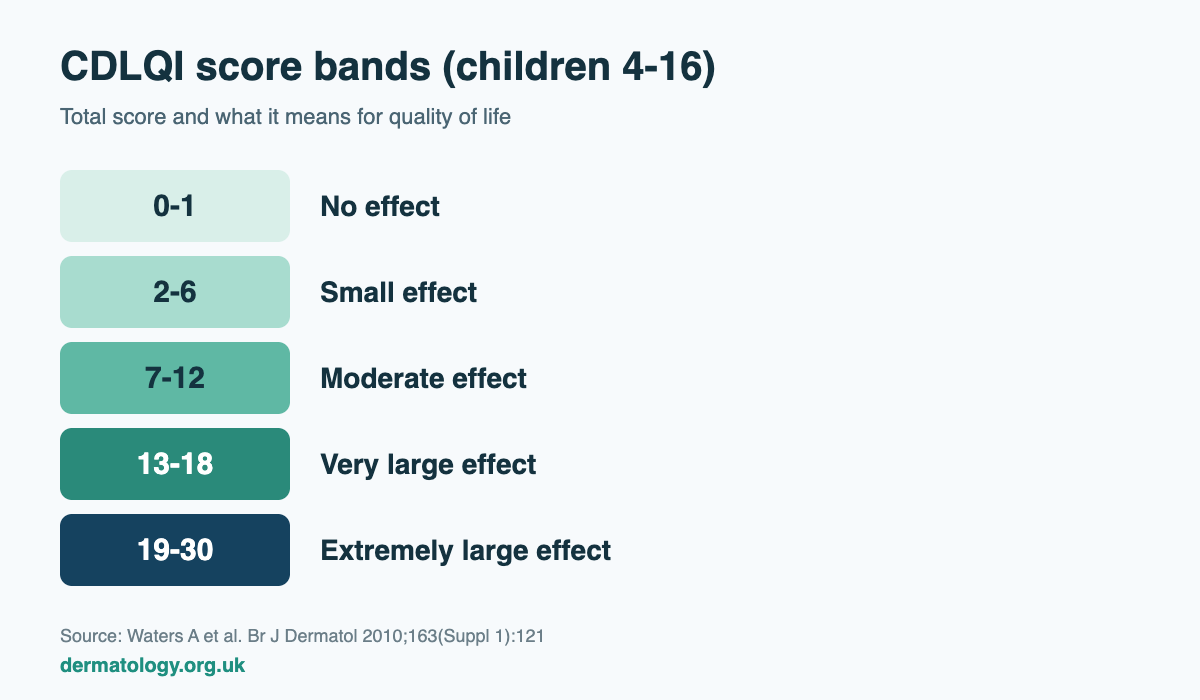
The Children's Dermatology Life Quality Index (CDLQI) measures impact of any skin disease on the lives of children. It is for age 4 to 16 (up to 15 years 11 months); text-only and Cartoon versions (Cartoon for younger children, nearly identical text), has 10 questions, asks about the last 7 days, and gives a total score from 0 to 30. Scores are grouped into bands: 0-1 no effect on child's life; 2-6 small effect; 7-12 moderate effect; 13-18 very large effect; 19-30 extremely large effect.
Table of Contents
How the CDLQI is scored
Each answer is scored as follows: Very much 3, Quite a lot 2, Only a little 1, Not at all 0, unanswered 0; Q7 'Prevented school' = 3. One unanswered = scored 0; two or more = not scored. Two boxes ticked = higher score; between boxes = lower score.. The answers are added together to give a total from 0 to 30. Higher scores mean a bigger impact on quality of life.
Respondents should complete it on their own, without being guided towards any answer, and the score numbers must not be printed next to the answer options. Under Cardiff’s general guidance, a questionnaire with one unanswered question can still be scored, but two or more unanswered questions make it invalid.
What CDLQI scores mean
| CDLQI score | Effect on quality of life |
|---|---|
| 0-1 | No effect on child's life |
| 2-6 | Small effect |
| 7-12 | Moderate effect |
| 13-18 | Very large effect |
| 19-30 | Extremely large effect |
Source: Waters A et al. Severity stratification of CDLQI scores. Br J Dermatol 2010;163(Suppl 1):121.
Who the CDLQI is for
Age 4 to 16 (up to 15 years 11 months); text-only and Cartoon versions (Cartoon for younger children, nearly identical text).
Authors: Dr M S Lewis-Jones and Professor A Y Finlay. First published: 1995. Original paper: Lewis-Jones MS, Finlay AY. Br J Dermatol 1995;132:942-949.
Copyright statement: © Children's Dermatology Life Quality Index. M S Lewis-Jones, A Y Finlay, May 1993 (Cartoon: June 1993; illustrations © Media Resources Centre, UWCM, Dec 1996). By agreement, Cardiff University now owns and administers the copyright.
Language versions: Several languages (Arabic, Chinese, French, German, Russian, Spanish and others); number not stated.
Cardiff publishes an official free app, 'CDLQI: The Official App', for Android and iOS.
Research and validation
- Cartoon version validation (Holme SA et al. Br J Dermatol 2003;148:285-290)
- Psychometric review 1995-2012 (Salek MS et al. Br J Dermatol 2013;169:734-759)
- Meta-analysis of childhood skin conditions (Olsen JR et al. Br J Dermatol 2016;174:853-861)
- DLQI vs CDLQI in psoriasis aged 16-17 (van Geel MJ et al. Br J Dermatol 2016;174:152-157)
- Skin disease vs other chronic childhood diseases (Beattie PE, Lewis-Jones MS. Br J Dermatol 2006;155:145-151)
How to get the CDLQI and when you need a licence
Patients and clinicians can use the CDLQI, in any available language, for routine clinical care without a licence and at no charge. It can be downloaded from Cardiff University’s CDLQI page. Data collected as part of routine care can also be analysed and published without a licence.
Students need a free licence, which must be requested by a member of staff at their institution, usually the research or medical supervisor, through Cardiff’s online form. A separate licence is needed for each questionnaire.
Any other use, such as a research study, needs a licence first. Cardiff charges per patient: £18 in the UK and $26 (USD) in the rest of the world, with VAT possibly payable in the UK and EU. The charge is based on the number of patients the questionnaire is given to, including everyone screened. CDLQI and Cartoon CDLQI have separate licences.
The wording, format and question order cannot be changed. Electronic versions need Cardiff’s formal permission, and the copyright statement must stay visible.
Related questionnaires
The CDLQI is one of a family of quality-of-life measures developed at Cardiff University. See the full guide to dermatology quality of life questionnaires, or the individual guides: DLQI · FDLQI · IDQOL · CADI · DFI · PDI.
Frequently asked questions
What does the CDLQI measure?
Who is the CDLQI for?
How is the CDLQI scored?
What is a high CDLQI score?
Is the CDLQI free to use?