
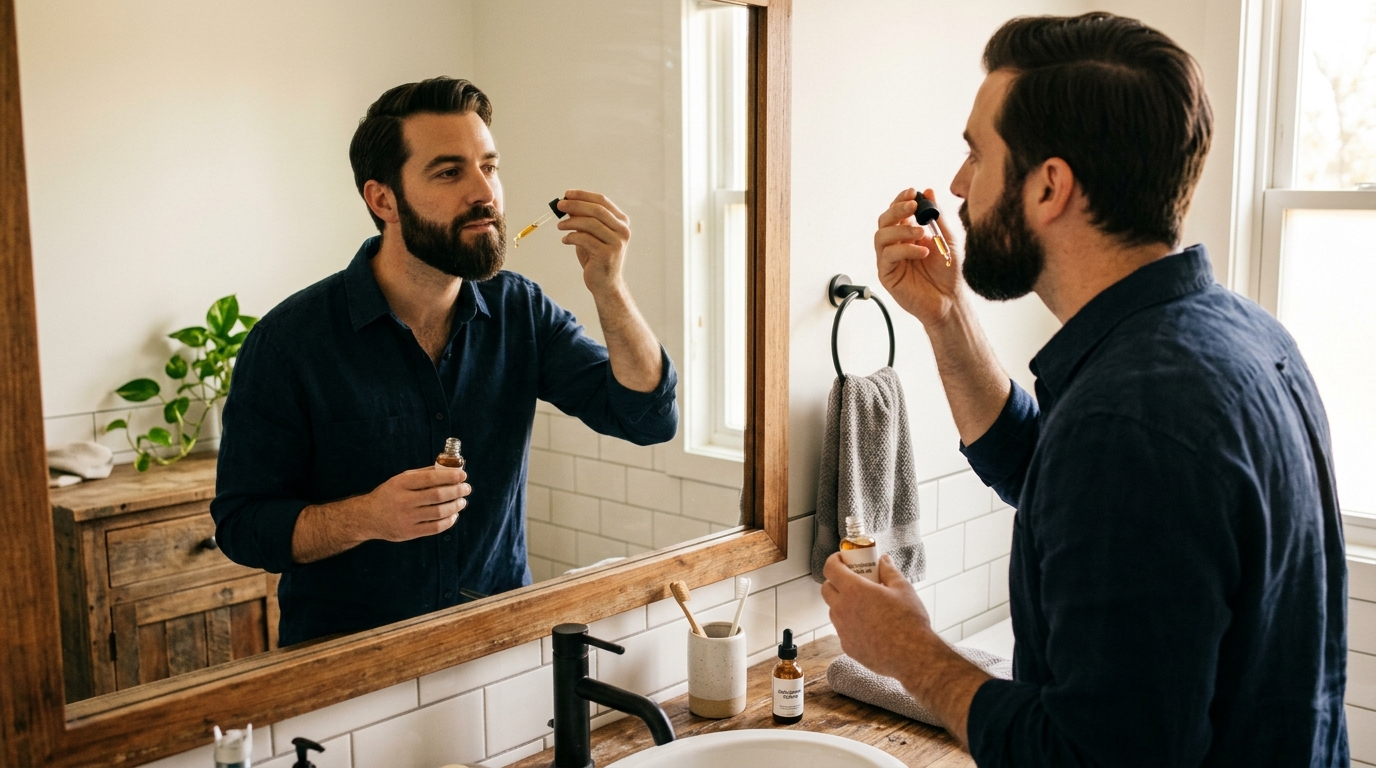
Plenty of men with a patchy or sparse beard look at minoxidil and wonder if it can fill the gaps. The honest answer is that it might, but the picture is more complicated than the before-and-after photos suggest. This guide gives you the real version: whether minoxidil for beard growth actually works, what the evidence shows, how to use it properly, a realistic timeline, the side effects worth knowing, what it costs in the UK, and whether it is safe and legal to use this way.
Table of Contents
- 1 Does minoxidil work for beard growth?
- 2 What is minoxidil, and why might it help a beard?
- 3 What does the evidence actually show?
- 4 Which minoxidil for a beard: 2% or 5%, foam or liquid?
- 5 How to use minoxidil for beard growth
- 6 A realistic results timeline
- 7 Shedding, stopping and maintenance
- 8 Side effects and precautions
- 9 Is minoxidil safe and legal to use on your beard in the UK?
- 10 What does minoxidil cost in the UK?
- 11 The honest caveats most articles skip
- 12 When to see a GP or dermatologist
- 13 Alternatives to minoxidil for a fuller beard
- 14 Frequently asked questions
- 15 Sources
Does minoxidil work for beard growth?
The short answer
Minoxidil can help thicken a patchy or sparse beard for some men, but it is off-label, the evidence is limited, and results are not guaranteed. Topical minoxidil is licensed in the UK for scalp hair loss, not facial hair, so using it on the beard is outside its approved purpose. A small clinical trial and a large amount of anecdotal reporting suggest it can increase facial hair density in some users, but the research base is far thinner than for scalp use, and any gains usually fade once you stop. Treat it as a “may help, with realistic expectations” option, not a guaranteed beard.
- Can thicken a patchy beard for some men
- Off-label — not licensed for facial hair
- Evidence is limited; results not guaranteed
- Gains usually fade if you stop
Months 0–1
No visible change yet. Keep going.
Months 2–3
Fine, soft vellus hairs may appear.
Months 4–6+
Some hairs thicken and darken for some men.
If you take one thing from this page: minoxidil works on the follicles you already have. It cannot create hair where there are no follicles, the result is not permanent, and anyone promising you a guaranteed full beard is overselling it.
What is minoxidil, and why might it help a beard?
Minoxidil is a topical solution or foam, most familiar in the UK under the brand Regaine. It is licensed and sold over the counter for hereditary hair loss on the scalp. It started life as a blood-pressure tablet, and the hair-growth effect was spotted as a side effect.
The leading theory is that minoxidil extends the active growing (“anagen”) phase of the hair cycle and widens small blood vessels near the follicle, which can support thicker, longer hairs over time. The exact mechanism is still not fully understood, even for scalp use.
The key point for beards is that minoxidil acts on existing follicles. Men with some patchy facial hair already tend to respond better than men with completely bare areas, because there has to be a follicle there for minoxidil to work on.
What does the evidence actually show?

This is where most beard articles either overstate the case or skip the detail. Here is the honest summary.
- The main clinical signal is a 2016 randomised controlled trial from Saudi Arabia. Men aged roughly 20 to 60 applied a 3% minoxidil lotion to the face twice a day for 16 weeks, and the minoxidil group showed greater improvement in facial hair count and density than the placebo group. It is a real, peer-reviewed result, but it is one relatively small study, at 3% rather than the 5% most people buy, over only 16 weeks.
- A 2024 review in the medical literature describes minoxidil for facial hair as an off-label use with promising but limited evidence, calling for larger trials. That is the consensus position: encouraging, not settled.
- Everything else is anecdotal, the before-and-after photos, forum threads and Reddit reports. Some men report genuinely transformative results, others report little or nothing. Anecdotes are not nothing, but they are not the same as repeated clinical proof.
So the fair read is: there is a modest clinical signal plus a lot of real-world enthusiasm, but nothing close to the depth of evidence behind minoxidil’s scalp use. There is also no reliable published figure for what percentage of men get a meaningful beard result, so be sceptical of any article quoting an exact success rate.
Which minoxidil for a beard: 2% or 5%, foam or liquid?
Strength: 2% vs 5%
In the UK, over-the-counter minoxidil mostly comes as 5% (for men) or 2%. The trial evidence for beards used 3%. In practice most men using it on the beard reach for the widely available 5% product, on the basis that the studied strengths sit at or below it. There is no UK guidance specifically recommending a beard strength, because beard use is off-label, so the higher strength also carries a higher chance of irritation. If your skin is reactive, starting lower and building up is the cautious approach.
Foam vs liquid (solution)
Both contain the same active ingredient. The practical differences matter more than the marketing.
| Feature | Liquid (solution) | Foam |
|---|---|---|
| Active ingredient | Minoxidil (commonly 5%) | Minoxidil (commonly 5%) |
| Contains propylene glycol | Usually yes | Usually no |
| Skin irritation risk | Higher for sensitive skin (propylene glycol is a common trigger) | Often gentler |
| Application precision | Easier to target small patches with the dropper | Can be harder to place precisely |
| Drying time | Slower | Faster |
If your skin is sensitive, or you get redness and flaking with the liquid, the foam (which usually leaves out propylene glycol) is the common switch. If you want to target a specific patchy area precisely, the dropper on the liquid is easier to control.
How to use minoxidil for beard growth
This is a general routine based on how topical minoxidil is normally used. Always read the leaflet that comes with your specific product, since concentrations and instructions vary.
Step 1: Start with clean, dry skin
Wash your face with a gentle cleanser and pat it fully dry. Applying to damp skin can spread the product beyond where you want it and may increase irritation.
Step 2: Apply a measured amount
Use the dose stated on your product leaflet, commonly around 1 ml of solution, or a set amount of foam, per application. More is not better. Overapplying raises the risk of side effects without adding benefit.
Step 3: Spread it over the patchy areas
Gently work the product into the skin of the beard area, focusing on the sparse or patchy spots. The aim is to get it onto the skin where the follicles are, not just onto existing hair.
Step 4: Let it absorb, then wash your hands
Allow it to dry fully before touching your face or applying anything else. Wash your hands straight afterwards so you do not transfer it to your eyes, scalp or other people.
Step 5: Be consistent
Topical minoxidil is typically used once or twice daily. Consistency over months matters far more than any single application. If you use it twice a day, space the applications out (for example morning and evening) and give each time to absorb.
A note on “leave-in time”: some users leave it on for a few hours before washing the area, and some just apply it to fit their routine. There is no strong UK guidance mandating a precise number of hours, so prioritise consistency and your product’s leaflet over rigid “rules” you read on forums.
A realistic results timeline
Beard growth with minoxidil is slow, and patience is the part most men underestimate. Rough expectations, based on how it behaves and on user reports:
- First few weeks: usually nothing visible. Some men notice fine, light “vellus” hairs appearing, which is normal.
- Around 2 to 3 months: early changes may start to show, often more of those fine hairs filling in patches.
- Around 4 to 6 months and beyond: if it is going to work for you, this is typically when fine hairs may begin to thicken and darken into more proper beard hair.
Most people who report success treat it as a multi-month, often year-plus, commitment. The “3-month rule” you will see in beard communities is really just a reminder that three months is too early to judge, not a guarantee that results arrive on schedule. If you have seen no change at all after several consistent months, it may simply not be working for your follicles, and that is worth raising with a pharmacist or GP rather than escalating the dose yourself.
Shedding, stopping and maintenance
Two things catch people out:
- Early shedding. As with scalp use, some men notice a short burst of shedding early on as follicles reset their cycle. It is usually temporary, but it can be alarming if you are not expecting it.
- Results are not permanent. This is the big one. Beard gains from minoxidil tend to fade if you stop, just as scalp gains do. Some men report that once the new hairs have fully “matured” they keep them after stopping, but there is no guarantee of that, and the safe assumption is that maintaining the result means continuing to use it. Factor in the ongoing cost and daily effort before you start.
Side effects and precautions
Most side effects from topical minoxidil are local and mild, but some are more serious and worth knowing before you start.
Common, usually mild:
- Redness, itching, dryness or flaking where you apply it (more likely with the propylene-glycol liquid).
- Irritation if it gets onto more sensitive skin near the eyes.
Less common but more important:
- Unwanted hair growth in nearby areas if the product spreads, for example onto the upper cheeks higher than intended.
- Minoxidil is absorbed through the skin, and there are occasional reports of effects linked to it reaching the bloodstream, such as dizziness, a fast or irregular heartbeat, swelling of the hands or feet, or unusual headaches. These are uncommon, but if you notice them, stop and seek medical advice.
Precautions:
- Keep it well away from your eyes, and do not apply to broken, irritated or sunburnt skin.
- It is not suitable in pregnancy or breastfeeding, and others (including pets) should avoid contact with treated skin until it has dried, as minoxidil can be harmful to pets.
- If you have a heart condition or take other medication, check with a pharmacist or GP before starting, because minoxidil has cardiovascular effects.
Because beard use is off-label, the leaflet warnings are written for scalp use. That does not make them irrelevant, the active ingredient and its risks are the same.
Is minoxidil safe and legal to use on your beard in the UK?
It is legal. Topical minoxidil up to 5% is sold over the counter in the UK without a prescription, and you are free to buy it. Using it on your face rather than your scalp is “off-label”, which is not illegal, it simply means you are using a licensed product outside its approved purpose, at your own discretion.
On safety, for many people it is tolerated, but two honest caveats apply. First, the safety data is written for scalp use, so the long-term effects of regular facial application are less well studied. Second, because it is absorbed through the skin, the cardiovascular precautions matter, especially if you have a heart condition or take other medicines. A pharmacist is a good, free first port of call in the UK to check whether it is suitable for you.
What does minoxidil cost in the UK?
Minoxidil is widely available over the counter at UK pharmacies and online, so beard users buy the same products as scalp users. Typical current prices (Amazon UK, accessed 22 June 2026, prices change and vary by retailer):
| Product | Format | Typical UK price |
|---|---|---|
| Regaine For Men Extra Strength Foam | Single 73ml (about 1 month) | Around £22.54 |
| Regaine For Men 5% Solution | Single 60ml (1 month) | Around £24.99 |
| Regaine For Men Foam, 3-month pack | 3 x 73ml | Around £42.99 |
| Regaine For Men 5% Foam (Boots) | 6-month supply | Around £84.54 |
| Own-brand / generic 5% minoxidil | 1 month | Around £18 to £25 |
A few honest points on cost:
- Generic own-brand 5% minoxidil (sold by direct-to-consumer brands such as Sons, and various Amazon UK sellers) is usually cheaper per month than branded Regaine, with the same active ingredient and strength.
- Kirkland-branded minoxidil, popular in the US, is not stocked on Amazon UK, so UK buyers usually default to Regaine or an own-brand equivalent rather than Kirkland.
- Because results are not permanent, the real cost is not one bottle, it is the ongoing monthly spend for as long as you want to keep the beard.
The honest caveats most articles skip
If you want the version a salesperson will not give you:
- It is off-label for beards. In the UK, topical minoxidil is licensed for scalp hair loss, not facial hair. You are using it outside its licensed purpose.
- Results are not permanent. As with scalp use, gains tend to fade if you stop. Maintaining results usually means continuing to use it, which is a long-term cost and commitment.
- It cannot beat your genetics. Minoxidil works on follicles you already have. If an area has no follicles at all, no topical will conjure hair there.
- Be wary of the “stack”. Beard communities often push dermarolling, specific supplements and avoiding so-called “DHT inhibitors”. Evidence for these add-ons in the context of beard growth is weak or absent, and aggressive dermarolling over minoxidil can increase how much is absorbed and the risk of irritation. More interventions do not equal more beard.
- Patchy beards are common and normal. A patchy beard is a cosmetic variation, not a medical problem. There is nothing wrong with deciding it is not worth a daily, indefinite, off-label routine.
For the bigger picture on how hair grows and is lost on the scalp and face, see our hair growth and loss guide.
When to see a GP or dermatologist
Consider getting professional advice if:
- You have a heart condition, take regular medication, or are unsure whether minoxidil is safe for you.
- You develop more than mild irritation, or any signs it may be affecting you beyond the skin (dizziness, palpitations, swelling).
- Your patchy facial hair appeared suddenly, in defined round patches, or came with hair loss elsewhere. Sudden patchy hair loss can be a condition such as alopecia areata, which is a medical issue rather than a cosmetic one and is worth having looked at.
- You have tried minoxidil consistently for several months with no change and want to know whether anything else is realistic for you.
A pharmacist is a good, free first port of call in the UK for checking whether an over-the-counter product is suitable. For how to arrange specialist care and what to expect, see how to see a dermatologist in the UK.
Alternatives to minoxidil for a fuller beard
Minoxidil is not the only route, and for some men it is not the right one:
- Give it time. Beards often keep filling in through the twenties and even into the thirties. A patchy beard at 19 is not the final result.
- Grooming and styling. Letting the beard grow longer so denser areas cover sparse ones, plus careful shaping, can make a patchy beard look fuller with no product at all.
- Beard “growth” oils and serums. Most marketed beard oils condition the hair and skin rather than grow new hair. They can make an existing beard look and feel better, but do not expect them to fill bald patches the way the minoxidil evidence suggests.
- A beard transplant. A surgical option that moves follicles into sparse areas. It is permanent and effective but expensive and involves a procedure, so it sits at the far end of the spectrum.
- Treating an underlying cause. If the patchiness is from a medical condition like alopecia areata, the right move is treating that condition, not reaching for an off-label cosmetic fix.
Frequently asked questions
Does minoxidil work on beards?
How long does minoxidil take to grow a beard?
Do I have to use minoxidil forever to keep my beard?
Which minoxidil is best for a beard, 2% or 5%, foam or liquid?
Is it safe and legal to use minoxidil on your face in the UK?
What does minoxidil cost in the UK?
Will minoxidil work on a completely bald patch with no hair?
This is general information, not medical advice. See a GP, pharmacist or dermatologist about your own skin and hair.
Sources
- NHS: Minoxidil
- NHS: Hair loss
- British Association of Dermatologists (BAD)
- DermNet: Minoxidil
- NICE / BNF: Minoxidil
- Saudi 2016 randomised controlled trial on topical minoxidil for facial hair (off-label use), and 2024 medical literature review of minoxidil for facial hair enhancement
- UK retailer price pages (Amazon UK, Boots), accessed 22 June 2026