
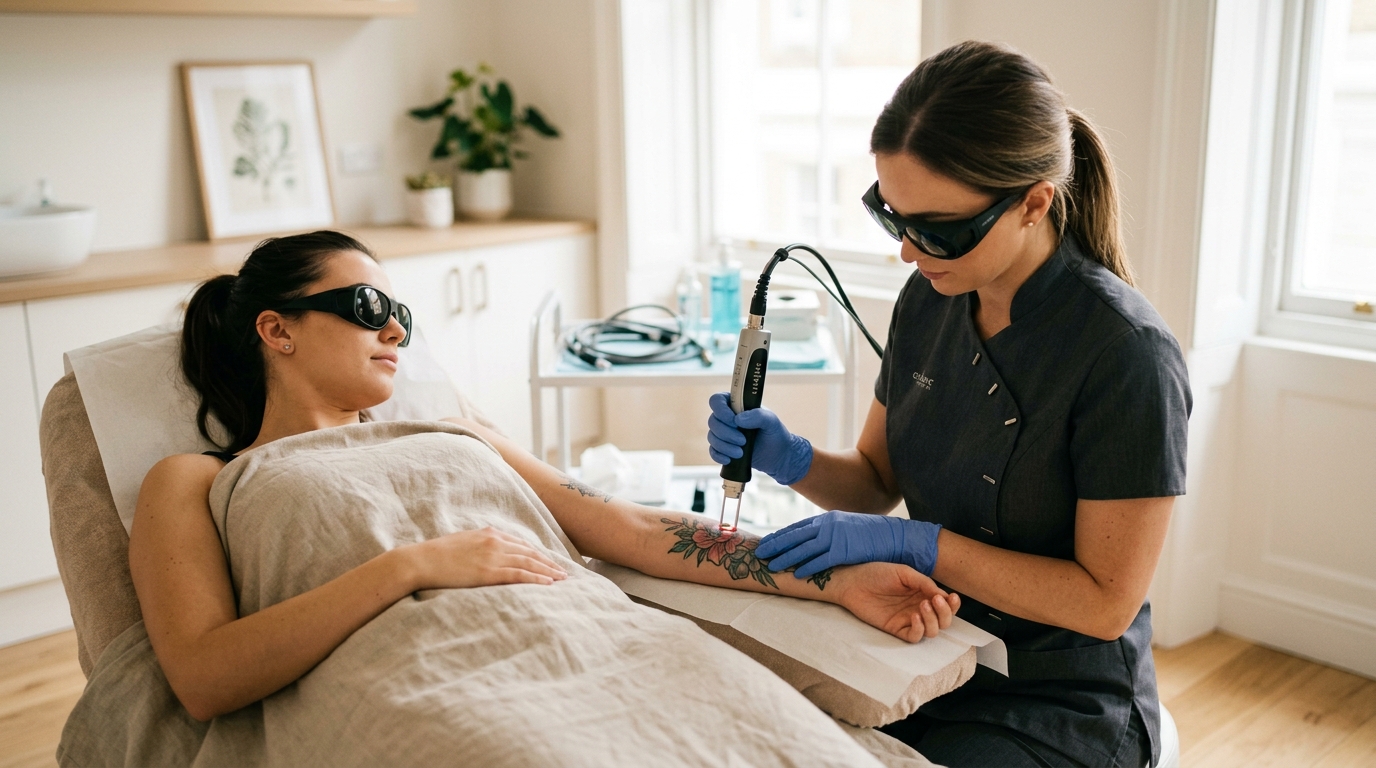
If you are looking up laser tattoo removal cost, you have probably already hit the problem: almost no clinic will give you a single number. Most pricing pages show a size-based table, then tell you the real price comes after a consultation. That is not them being awkward. Tattoo removal is genuinely priced per session, and the number of sessions you need depends on your specific tattoo.
This guide gives you the real numbers anyway: what laser tattoo removal actually costs in the UK in 2026, broken down per session and by tattoo size, with published prices from named clinics so you can see the true spread. It is written from the buyer’s side, not the clinic’s.
Table of Contents
- 1 How much does laser tattoo removal cost in the UK?
- 2 Why there is no single price (and that is normal)
- 3 Laser tattoo removal cost per session by tattoo size
- 4 Real UK clinic prices compared (2026)
- 5 Laser tattoo removal cost by total course
- 6 How many sessions will I need?
- 7 The 5 things that actually drive the price
- 8 Does it hurt?
- 9 Aftercare: what you are signing up for between sessions
- 10 Can you get tattoo removal on the NHS?
- 11 How to compare clinic quotes without overpaying
- 12 When to see a dermatologist or GP
- 13 Frequently asked questions
- 14 Sources
How much does laser tattoo removal cost in the UK?
The short answer
Laser tattoo removal in the UK typically costs £35 to £200 per session, with most full removals totalling £300 to £1,500. Small tattoos start at around £34 to £50 per session and clear in roughly 6 to 8 sessions, so the realistic total runs from about £200 to £500. Large or full-sleeve tattoos run £115 to £200+ per session and need many more sessions, pushing the total well past £1,000. Black ink on lighter skin is cheapest and fastest; coloured, dense or large tattoos cost more on both counts. Consultations and patch tests are usually free, and the NHS does not fund cosmetic tattoo removal.
- Per session: £35–£200 by tattoo size
- Most tattoos need 6–12+ sessions
- Typical full removal: £300–£1,500+
- NHS does not fund cosmetic removal
Per session
- Priced per session, by tattoo size
- Q-switch or Pico laser
- Free patch test first
Full removal
- Usually 6 to 12+ sessions
- Spread over many months
- Total depends on size & colour
If you only take one thing from this page: the per-session price is the headline, but the number of sessions decides your final bill. A cheap per-session rate means little if your tattoo needs twice as many treatments. Always get an itemised written quote and the clinic’s estimated session count before you commit.
Why there is no single price (and that is normal)
Laser tattoo removal is charged per session, not as a flat “remove this tattoo” fee. A small tattoo might be cleared in a handful of sessions; a large, colourful or older one can take many more. Because the total is “price per session multiplied by number of sessions,” two people can pay very different amounts for tattoos that look a similar size.
So the honest answer to “how much to remove a tattoo?” is: it depends on size, colour, ink depth, your skin, and how completely you want it gone. The rest of this page breaks each of those down, with real prices, so you can estimate your own range before you ever speak to a clinic.
Laser tattoo removal cost per session by tattoo size
Size is the single biggest driver of the per-session price, because lasers treat a defined area per pulse. Here is the typical UK per-session spread by size, based on published 2026 clinic prices. Treat it as a budgeting starting point, not a quote.
| Tattoo size | Typical single-session price | Course (per-session) price | Likely sessions for full removal |
|---|---|---|---|
| Very small (1-3cm, e.g. a small symbol) | £34 to £75 | £36 to £60 | 6 to 8 |
| Small (4-6cm) | £54 to £128 | £54 to £100 | 6 to 8 |
| Medium (7-15cm, palm-sized) | £80 to £208 | £80 to £160 | 6 to 10 |
| Large (16-20cm) | £117 to £318 | £110 to £250 | 8 to 12+ |
| Extra large / full sleeve (20cm+) | £155 to £200+ (often custom-quoted) | Custom package | Many, often 10+ |
| Consultation / patch test | Free at most clinics | — | One-off |
A few things to read from that table. First, the course price is lower than the single-session price at most clinics, because you commit to a block of treatments up front. Second, clinics band their pricing by physical dimensions, and the bands do not line up exactly between providers, which is why direct price comparison is fiddly. Third, picosecond (“Pico”) lasers, used for stubborn or coloured ink, sit in a higher price band than standard Q-switched lasers at the same size.
Watch the “course price” headline
Clinics often advertise the lower, course-committed per-session price as the headline number. That figure only applies if you buy the whole course up front. The single-session pay-as-you-go price is usually higher. Make sure you are comparing like for like when you weigh up quotes.
Real UK clinic prices compared (2026)
Most cost guides give you a vague range, and the biggest US guides quote dollars that do not help a UK buyer. Here are actual published 2026 prices from named UK clinics so you can see the real spread. Confirm directly with the clinic before booking, as prices change and depend on your exact tattoo.
| Clinic | Coverage | From (per session) | Course pricing | Consultation |
|---|---|---|---|---|
| Pulse Light Clinic | London + Manchester | From £34 (Q-switch, 1-2cm); from £39 Pico | e.g. £309 for 8 sessions on a very small tattoo | Free consult + patch test |
| Faith Laser | Liverpool | £37 (XS up to 4x4cm) | Course of 6 from £190 (XS) to £775 (XL) | Free consult + patch test |
| London Premier Laser | London (5 clinics) | From £49.33 (small 1-4cm); £47-£80 single 1×1 inch | Package per-session rates fall with volume | Free consult + patch test |
| sk:n Clinics | National | £75 single (very minor 1-3cm); £60 in a course of 8 | Course of 8 from £60/session (small) to £250/session (major) | Free; £50 test patch |
| Perfect Skin Solutions | Portsmouth area | Around £50 per session | Quoted on assessment | On assessment |
The story in that table: a single small-tattoo session ranges from about £34 to £75, while a large tattoo can be £200 to £318 per session at the top end. Location matters (London and national chains sit higher), and so does the laser type. Where you go matters as much as what you are having done.
For context, the largest US cost guides quote roughly $200 to $500 per treatment, which is a US market figure and not a useful UK benchmark. UK per-session prices are generally lower in absolute terms, but the multi-session reality is the same.
Laser tattoo removal cost by total course
The per-session price is only half the story. What you actually pay is the per-session price multiplied by the number of sessions, and most tattoos need a full course. Here is what a realistic total looks like.
- Very small black tattoo: around 6 to 8 sessions. At roughly £34 to £50 per session, that is about £200 to £400 total. Some clinics package this, for example around £309 for 8 sessions on a very small tattoo.
- Small to medium tattoo: 6 to 10 sessions at £54 to £160 per session, so roughly £400 to £1,200 total depending on colour and clinic.
- Large or coloured tattoo: 8 to 12+ sessions at £115 to £250+ per session, commonly £1,000 to £2,500+ total.
- Full sleeve or extra large: usually custom-quoted; budget several thousand pounds and a course running well over a year of calendar time.
The takeaway: budget for a course, not a one-off, and ask the clinic for an estimated session count in writing. A low per-session price attached to a high session estimate can cost more than a higher per-session price with fewer sessions.
How many sessions will I need?
This is the question that decides your total bill, and no honest clinic can promise an exact number in advance. Removal happens gradually: each session breaks ink into smaller particles that your immune system then clears over the following weeks, which is why sessions are spaced out.
What is well established from UK clinic guidance:
- Most tattoos need 6 to 8 sessions, and many need a longer course of 8 to 12 or more. A small, older, black tattoo usually needs fewer sessions than a large, recent, multi-colour one.
- Sessions are spaced roughly 6 to 8 weeks apart (sk:n advises a minimum of 6 weeks; several London clinics use 6 to 8) to let the skin recover and the body clear broken-down ink. Because of that gap, full removal commonly stretches across 8 to 18 months of calendar time, even when the number of sessions is modest.
- A realistic clinic gives you an estimated range at consultation (for example, 6 to 10 sessions for a typical black tattoo) and reviews progress as you go, rather than charging you for a fixed block and disappearing.
If a clinic guarantees complete removal in a specific small number of sessions, be sceptical. Results vary between people even with identical tattoos.
The 5 things that actually drive the price
1. Size
The biggest single factor. A bigger tattoo means a longer session and a higher per-session price, which is why every clinic bands its pricing by physical dimensions. It also tends to need more sessions, so size hits the total twice.
2. Colour
Black is the easiest and cheapest ink to remove because it absorbs all laser wavelengths well. Colours are harder. Greens, light blues, yellows and pastels can be stubborn and often need a specific wavelength or a newer picosecond (“Pico”) laser, which is priced in a higher band. A multi-colour tattoo can need more sessions than a black one of the same size, raising the total even when the per-session price looks similar.
3. Age and depth of the ink
Older tattoos have often faded a little and sit shallower, which can make them respond faster and finish in fewer sessions. Deep, dense or heavily layered ink (including cover-ups and saturated professional work) takes more passes. Amateur “stick and poke” tattoos are sometimes shallower but unpredictable.
4. Your skin
Laser removal targets the pigment without damaging the surrounding skin. On darker skin tones there is a higher risk of the laser affecting natural skin pigment, which can leave a lighter or darker patch (sometimes called ghosting). Reputable clinics adjust the laser settings, may use specific wavelengths such as the PicoWay on darker skin, and sometimes recommend more, gentler sessions. This is a safety point as much as a cost point, and it is one reason a proper consultation and patch test matter.
5. How completely you want it gone
Full removal costs more than fading. If your goal is to lighten a tattoo so it can be covered with a new design, you usually need far fewer sessions than you would to clear the skin completely. Tell the clinic which outcome you actually want, because “fade for a cover-up” and “remove entirely” are different jobs at different prices.
Does it hurt?
Yes, somewhat. It is generally described as uncomfortable rather than unbearable, and most people compare it to an elastic band repeatedly snapped against the skin, or a fast series of hot pinpricks. Smaller tattoos are over quickly.
Clinics manage the discomfort with cooling (a chilled-air device or cooling spray), and some can apply numbing cream beforehand. Some areas of the body (ribs, ankles, inner arm) tend to feel more sensitive than others. If pain is a real worry, ask the clinic what cooling or numbing they offer before you book. The pain is short-lived and ends with the session.
Aftercare: what you are signing up for between sessions
Aftercare affects your results and your time even when it is not a line item on the bill. Typical, widely recommended aftercare includes:
- Keeping the area clean and covered with ointment and gauze for the first 48 hours, as advised.
- Not picking at any blistering or scabbing. Let it heal naturally to reduce scarring risk. Frosting and small blisters straight after treatment are normal.
- Avoiding sun exposure on the area and using a high-factor SPF once healed. Sun on a healing site raises the risk of pigment changes.
- Avoiding swimming pools, saunas, very hot baths and heavy exercise for a few days, per your clinic’s instructions.
- Waiting the full recommended gap before the next session. Rushing it does not speed up removal and can irritate the skin.
Good aftercare protects the result you are paying for. Poor aftercare, especially sun exposure and picking, is a common reason for patchy results and pigment changes.
Can you get tattoo removal on the NHS?
In almost all cases, no. Tattoo removal is treated as cosmetic and not available on the NHS, so you should expect to pay privately. The NHS will not generally fund removal of a tattoo you chose to get.
There are narrow exceptions, usually where a tattoo is causing genuine medical or significant psychological harm, and these are decided case by case by your GP and local NHS commissioning rules, not guaranteed. If you think your situation might qualify, the route is to speak to your GP rather than assume. For everyone else, this is a private-pay treatment, which is exactly why comparing clinics on price and quality matters.
How to compare clinic quotes without overpaying
A few buyer-side moves that save money and reduce risk:
- Get the per-session price and the estimated session count separately. A low per-session price means little if the clinic expects you to need twice as many sessions.
- Ask what laser they use and whether it suits your ink colours and skin tone. For coloured tattoos or darker skin, ask specifically how they handle the harder cases (Pico lasers are the usual answer).
- Confirm what the consultation and patch test cost. Most UK clinics offer these free; sk:n charges around £50 for a test patch.
- Ask whether you pay per session or must buy a course up front. Pay-as-you-go protects you if your tattoo responds faster than expected. A prepaid course is cheaper per session but locks in your spend.
- Check who performs the treatment and that the clinic is properly regulated for laser use in your nation of the UK (CQC in England, HIW in Wales, HIS in Scotland).
- Be wary of unusually cheap deals. Tattoo removal done badly can scar or leave pigment changes that are harder to fix than the original tattoo.
If you are weighing up tattoo removal against removing another type of mark, our guide to skin tag removal cost in the UK follows the same buyer-first, real-prices approach.
When to see a dermatologist or GP
Most laser tattoo removal happens at cosmetic or laser clinics rather than on the NHS, but there are times to involve a doctor:
- You have a darker skin tone and want to understand your specific risk of pigment changes before committing.
- You have a skin condition (such as eczema or psoriasis), a keloid or hypertrophic scarring history, or you are immunosuppressed.
- A mole, lump or changing mark sits within or near the tattoo. Get that assessed before any laser goes near it.
- You develop infection signs (spreading redness, heat, pus, fever) or unusual blistering after a session.
- You are pregnant or breastfeeding. Most clinics will not treat you during this time.
If you want a medical opinion before spending money on a course, you can start with your GP. For how to access dermatology care in the UK, including NHS referral routes and going private, see how to see a dermatologist in the UK and dermatologists in London.
Frequently asked questions
How much does laser tattoo removal cost in the UK?
How much does it cost to remove a small tattoo?
Why won’t clinics just tell me the total price?
Is laser tattoo removal cheaper for small or black tattoos?
Can you get tattoo removal on the NHS?
How many sessions does laser tattoo removal take?
Is it cheaper to fade a tattoo than fully remove it?
Does laser tattoo removal hurt?
This is general information, not medical advice. Costs, suitability and results vary from person to person. See a GP or dermatologist about your own skin, and get an itemised written quote from any clinic before you commit.
Sources
- NHS: Tattoo removal and cosmetic procedures guidance
- British Association of Dermatologists (BAD): patient information on lasers and skin procedures
- DermNet: laser tattoo removal overview
- NICE: guidance on cosmetic and laser procedures
- UK clinic price pages, accessed June 2026: sk:n Clinics, Pulse Light Clinic, London Premier Laser & Skin Clinic, Faith Laser (Liverpool), Perfect Skin Solutions (cited as provider examples, not endorsements)